Showing posts with label Christmas Carols. Show all posts

Tuesday, December 27, 2011

God Rest Ye Merry Gentlemen: GENTLEMEN

Sure, the presents have all been opened, the dinners have been eaten, the stockings probably are even now being put away--but I still have one Christmas post left this year.

The word gentleman does not mean today what it did a little over one hundred years ago.  I could write up a nice and neat little etymological diatribe about the how's and why's of the change--but someone already did so in a far more efficient form than I could ever hope to manage.  The following is a portion of Mere Christianity which is itself a collection of materials shared by C.S. Lewis (at the request of Winston Churchill) over British radio during the rampant bombings by German forces on English soil during World War II.

The word gentleman originally meant something recognisable; one who had a coat of arms and some landed property. When you called someone "a gentleman" you were not paying him a compliment, but merely stating a fact. If you said he was not "a gentleman" you were not insulting him, but giving information. There was no contradiction in saying that John was a liar and a gentleman; any more than there now is in saying that James is a fool and an M.A.  But  then  there  came   people   who  said-so  rightly,   charitably, spiritually,  sensitively,  so  anything  but  usefully-"Ah, but  surely the important thing about a gentleman is not the  coat of arms and the land, but the behaviour?  Surely he is the true gentleman who behaves as a gentleman should?  Surely in that sense Edward is far more truly a gentleman than John?"

They meant well. To be honourable and courteous and brave is of course a far better thing than to have a coat of arms.  But it is not the same thing.  Worse still, it is not a thing everyone will agree about. To call a man "a gentleman" in this new, refined sense, becomes, in fact, not a way of giving information about him, but a way of praising him: to deny that he is "a gentleman" becomes simply a way of insulting him. When a word ceases to be a term of description and becomes merely a term of praise, it no longer tells you facts about the object: it only tells you about the speaker’s attitude to that object.  (A “nice” meal only means a meal the speaker likes.)

A gentleman, once it has been spiritualised and refined out of its old coarse, objective sense, means hardly more than a man whom the speaker likes. As a result, gentleman is now a useless word. We had lots of terms of approval  already,  so it was not needed for that use;  on the other hand if anyone  (say, in  a historical work) wants  to  use  it in its old sense, he cannot do so without explanations. It has been spoiled for that purpose.

Now if once we allow people to start spiritualising and refining, or as they might say "deepening,” the sense of the word Christian, it too will speedily become a useless word.  In the first place, Christians themselves will never be able to apply it to anyone. It is not for us to say who, in the deepest sense, is or is not close to the spirit of Christ. We do not see into men's hearts. We cannot judge, and are indeed forbidden to judge.

It would be wicked arrogance for us to say that any man is, or is not, a Christian in this refined sense. And obviously a word which we can never apply is not going to be a very useful word. As for the unbelievers, they will no doubt cheerfully use the word in the refined sense.  It will become in their mouths simply a term of praise. In calling anyone a Christian they will mean that they think him a good man.  But that way of using the word will be no enrichment of the language, for we already have the word good. Meanwhile, the word Christian will have been spoiled for any really useful purpose it might have served.

"God Make You Mighty, Land Owners"

That would be the more accurate title and first line of the song then.  A title which would seem to suggest the importance of stewardship and responsibility over what you have been given, as well as the implication that when you have been granted much, much is required.

Wednesday, December 21, 2011

God Rest Ye Merry Gentlemen: MERRY


A lot of religious music used by the church in the 15th century had been written in Latin.  These songs were generally sung to sad or somber melodies that didn't evoke a lot of enthusiasm or joy.  So, in their own circles peasants wrote songs of their own using more uplifting religious themes and melodies.  Many of these folk songs are what we think of when someone says "Christmas carol."

God Rest Ye Merry Gentleman certainly falls into this category.  In fact, this song was such a lively tune in comparison that it was typically danced to as they sang it; and it was easily the most popular Christmas carol of it's day.  In fact, it's lyrics were actually closer to the Biblical account of Jesus' birth than many of the songs being sung in the church at the time.  Despite it's popularity among peasants, it would not be published until the 19th century during Queen Victoria's reign.  First printed for the Anglican church, it soon became popular all over the world.

Words change over time.  They change a lot.  An entire branch of study called etymology (sort of a mash-up of history and grammar) exists that researches the older and original meanings of words that often fall out of use.  Though not quite as astute in this branch of study as I would like to be, it holds a wealth of information, and understanding, concerning the meaning of antique language and literature.  If you read my previous post you already understand that.

Today when we think of the word Merry we are thinking of a synonym for happy, joyful, or festive.  That is the popular use of the word in this present era.  However, in the Middle Ages the word meant something altogether different--it was a word used to describe armies, soldiers, and rulers!  In Middle Age English it literally meant great, strong, or mighty!

The charge of the song then, when taking into consideration the meaning I previously discussed for rest is God Make You Mighty...  In comparison to the downer songs of their day this song was not only a tune of celebration, but for the Middle Age peasants who wrote, loved, and popularized it... it was a battle cry.  In fact the seasonal salutation "Merry Christ Mass" was thought to be such a powerful and happy notion to the peasants that it actually influenced the change in the meaning of the word to become what we understand today.

Mighty Christmas to all!

Monday, December 19, 2011

God Rest Ye Merry Gentlemen: REST

God Rest Ye Merry Gentlemen...

I've already posted about this song once this Christmas season, but it is my favorite holiday tune.  So, I want to add a little more by kicking off a short series that focuses entirely on the first line, and title, of the tune.

Rest has a few different definitions. Check out the dictionary.com and Hebrew definitions.

One definition that immediately jumped out at me was this one:


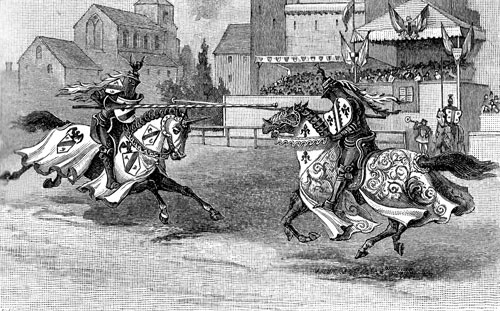
noun:  a support for a lance
Origin:1490–1500; variant of arrest


Now, I'm not saying that this is specifically the definition the unknown author of this darling song was leaning on; but it could be.  Especially given the context and the etymology of the last two words in the line (which is what my next two blogs are about).

Out of all the definitions of rest that I've read this one makes the most sense.  It basically means God rests you in Him.  No, not a nap.  Not a vacation.  God holds you close.  He puts you where you need to be so that you can live up to your proper use.  
A lance would be "rested" between the arm and side as the advancing combatant was preparing to drive his long sharpened stick through an enemy.  Not exactly what we think of when we think of rest.  "Rest" for a lance was the moment of placement before impact.

God rest me indeed.